
A watch that set the direction and future of Rado

One can hardly believe it has been 60 years now since Rado unveiled DiaStar in 1962, a watch that revolutionised the watch industry with a uniquely designed shield-like tonneau tungsten-carbide case. It was extremely scratch resistant and together with ‘square-effect’ sapphire crystal glass, it was almost indestructible. During that era, watches were mostly made of steel or precious metal with ordinary mineral glass. From then on, DiaStar not only set the direction and fate for Rado and earned the watch company the moniker Master of Materials, but it also led the industry to utilise the sapphire glass, which eventually became an industry standard.
As we all know, our wristwatch gets bashed about quite a bit in our daily life and challenges, DiaStar’s tungsten-carbide is an attractive alternative as it hardly wears off or deteriorates in aesthetics,. it continues to look like new even after years of wearing. For that durability, it gained a lot of happy fans along the way.
Of course, Rado went made many other super-resistant materials, especially ceramics. DiaStar eventually disappeared from production, but was relaunched in 2015 with the same unique aesthetics.

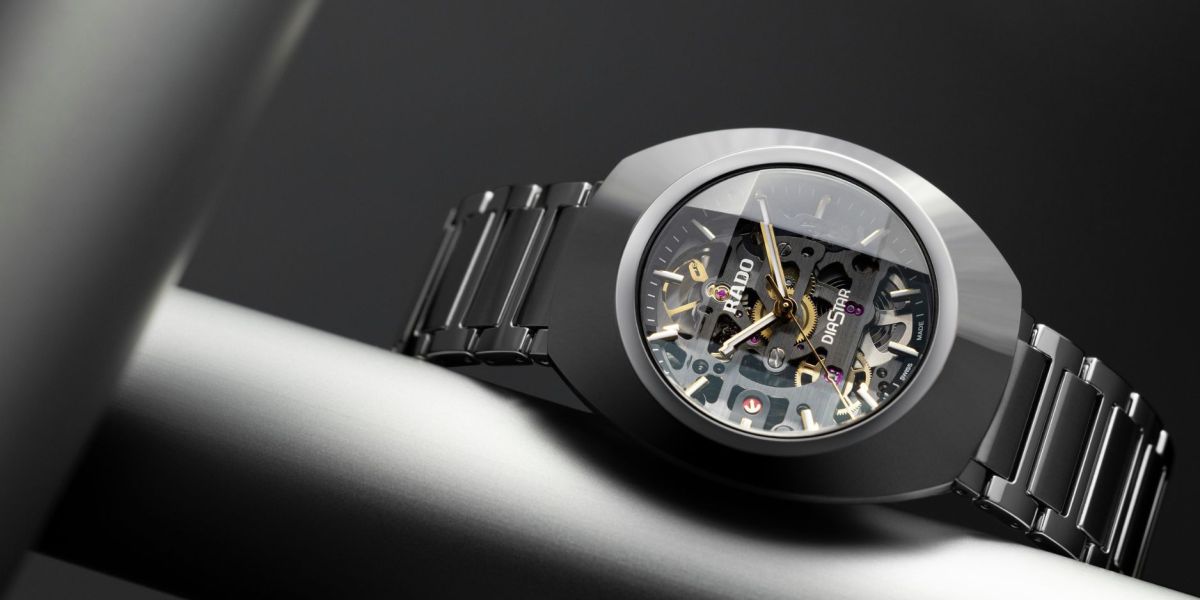
To celebrate DiaStar's 60th Anniversary this year, Rado unveiled the commemorative piece, the DiaStar Original Skeleton. This time round the timepiece in discussion, is made of another proprietary material, the Rado Ceramos, another uber hard material. The watch is designed with the same code as the Rado of 1962, slight tweaks in its design were done to it to make it more up-to-date and in synch with modern times.

The large and prominent Ceramos bezel has a brushed matte finish that dictates the shape of the entire watch as it was 60 years ago, and it remains an icon even through decades of evolution. Today the anniversary edition takes it a step further, it is given a skeletonised movement, with a treated anthracite-grey ‘rectangular’ bridge that spanned across the openwork, exposing the working beauties in grey and gold. The dial is framed by a black inner bezel which hosts the gold-coloured SuperLuminova indexes and is repeated on the hours and minutes hands with a long gold second hand. The gold in the parts of the movement and the gold above the dial set off a rather attractive contrast against the grey. They are viewed through a very clever and fantastic square-faceted sapphire crystal.

The automatic Rado Calibre R808 has an anti-magnetic Nivachron hairspring, a much-needed feature. It may not be decorated, but it is well-finished and coated in anthracite, apart from those gold parts. It comes with 80 hours of power reserve. Overall, they look rather chic and handsome when housed in a 38mm X 45mm grey polished Ceramos bezel with a stainless steel middle case and the square-effect bevelled crystal protecting the movements below. It comes with an ‘H’ links brush polished bracelet. Still unique, iconic and an utterly attractive timepiece.
{youtubesub)
