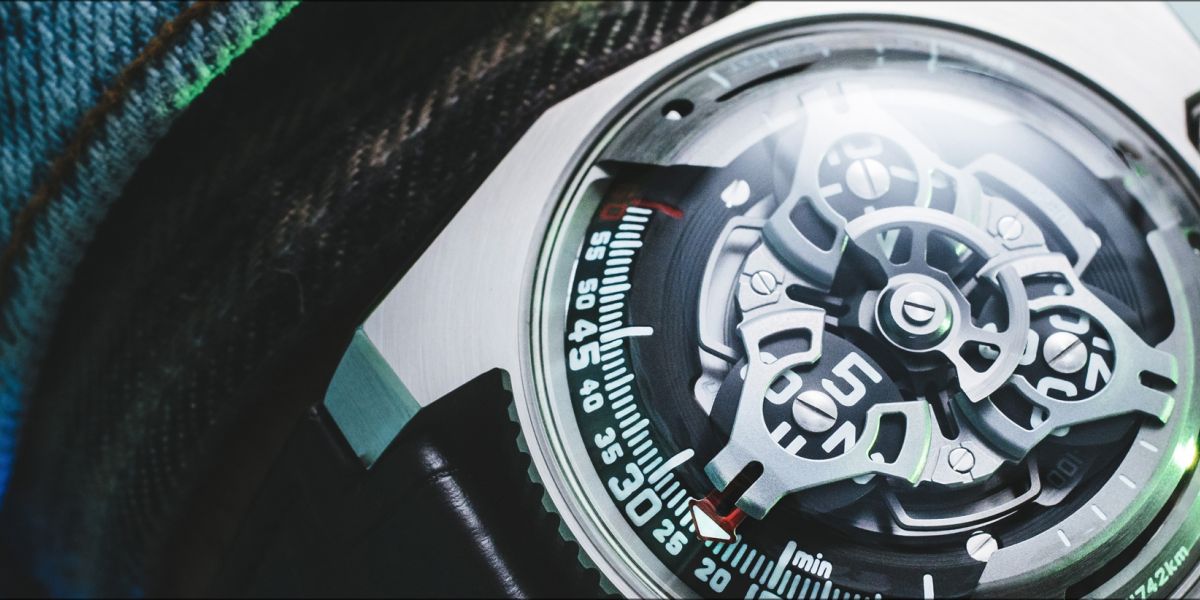

Urwerk revisits its iconic wandering hour satellites.

The UR-100 SpaceTime might be touted as one of Urwerk’s most basic time instruments to date, but it’s still far from being your bog-standard three-hander. We have, of course, come to expect nothing less from creative mavericks, Felix Baumgartner and Martin Frei. It’s a well-known fact that both men have a long-term fascination with time and space, and therefore, have merged both concepts in one watch.
Urwerk’s iconic orbital hour satellites remain the focal point but differ in one significant way. In past iterations, the red arrow-tipped minute pointers on the hour satellites disappeared after 60 minutes when replaced by the next. In the UR-100 SpaceTime, however, the minute arrow (actually one of three) passes beneath and between subsidiary dials, reappearing to display two new astronomical indications.

The first is the distance travelled in kilometres on Earth. It is evaluated by the indicator at 10 o’clock based on the average speed of our planet’s rotation on its axis at the equator, or the equivalent of 555km every 20 minutes. The second is the distance travelled by the Earth around the sun, as denoted by the indicator at two o’clock. This journey spans approximately 35,740km every 20 minutes.

The UR-100 SpaceTime is powered by the automatic Calibre 12.01. It is regulated by Urwerk’s latest turbine, called the Windfäng (Swiss German for ‘air trap’), which minimises shocks, over-winding and wear and tear. The rotor, which is partially supported on its periphery by the flat turbine, also has a larger diameter, resulting in a lower mass, and therefore, less wear. The calibre’s design and construction were particularly tricky due to the extremely narrow gap between the minute hands, three different dials and domed sapphire crystal.

If the eye-catching proportions of the UR-100 SpaceTime’s titanium and steel case look familiar, that’s because chief designer Frei looked to the aesthetics of early Urwerk watches, in what he calls a ‘Back to the Future’ moment. “We broke down our approach and used some of the original design elements of our early constructions,” he explains. “The case of the UR-100 is a deconstruction of an early Urwerk case. The steel dome of our historic models is reproduced in sapphire crystal.” A few practical considerations were included too, such as grip-friendly fluted edges along the elongated octagonal case and a crown nestled in a recess at 12 o’clock.
One of the translations of the name ‘Urwerk’ is ‘original movement’ in German. Baumgartner and Frei have always stated that their creations are a tribute to generations of watchmakers whose work has resulted in what we know today as haute horlogerie. Fittingly, the UR-100 SpaceTime is inspired by a 19th-century pendulum clock that shows the distance of the Earth’s rotation at the equator, as made by Gustave Sandoz for the 1893 World’s Fair in Chicago. As humanity’s obsession with time, and its near relations, distance and speed, continues, we can’t think of better disruptors to carry on pushing the accepted norms of its measurement.
|
Case |
41mm x 49.7mm in titanium and steel (UR-100 Iron) or titanium and steel with black DLC (UR-100 Black) |
|
Dial |
Open dial with three orbitals |
|
Movement |
Self-winding Calibre UR 12.01 |
| Black alligator leather (UR-100 Iron) or black technical fabric (UR-100 Black) | |
|
Functions |
Hours, minutes, distance travelled on Earth's equator in 20 minutes, distance Earth travels around the Sun in 20 minutes |
| 48 hours | |
|
Price |
RM205,200 |
